
“Aristotle contemplating the bust of Rembrandt.”
A student with Down syndrome said that to a Metropolitan Museum of Art guide in New York City. Unprompted. During a school tour.
The guide later wrote to the school. She had never seen students more engaged or who knew more about art than the students from The Camphill School.
That’s what The Camphill School in Glenmoore, Pennsylvania, does.
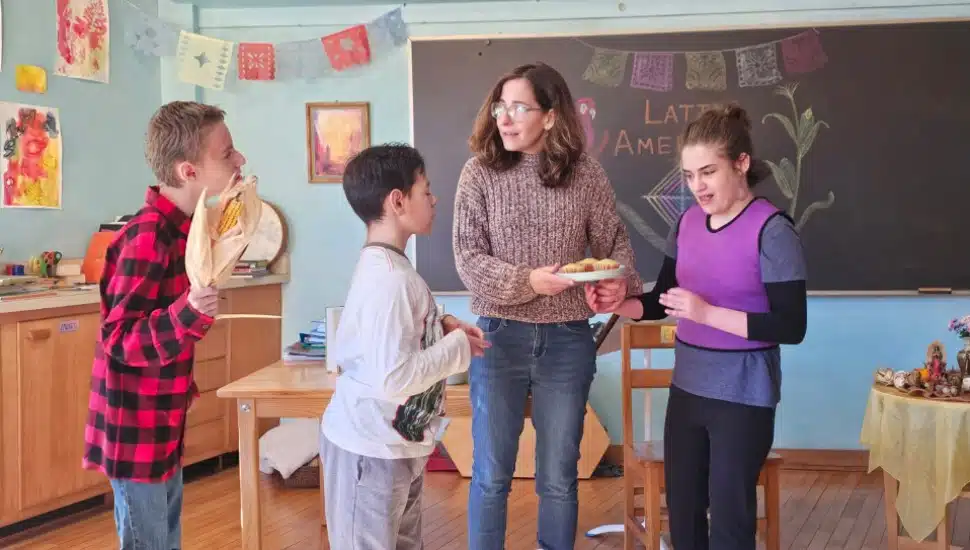
Here, children and young adults with intellectual and developmental disabilities don’t just learn about the world. They contribute to it.
Part of the international Camphill Movement, founded in 1940, The Camphill School has been rooted in Glenmoore since 1963. Accredited by both the Middle States Association and AWSNA as a Waldorf school, it serves students from first grade through age 22, offering day and boarding programs, including a Transition Program at Beaver Farm, a 130-acre working farm in Phoenixville.
Students there grow organic produce, tend livestock, run a two-acre cut flower operation called Foxfield Flowers, and cook daily meals for 80 people — farm to table, from fields they can see out the window.
“We’re not learning to cook in a classroom set up to have a kitchen,” Guy Alma, a long-time Camphill community member, explains. “We’re cooking for 80 people in a commercial kitchen. We haven’t got a few goats out the back — we’re working on a farm that produces every day, with wholesalers coming to pick up $3,000 worth of flowers on Wednesday.”
That authenticity reaches students who struggle in traditional classrooms, including those on the autism spectrum. It unlocks growth that parents didn’t think was possible.
It’s a rich, classic curriculum with the arts, history, music, and movement, but it’s expressed through doing things, storytelling, and art, making it come alive for students with intellectual disabilities.
Camphill’s residential program goes further. Boarding students live in on-campus homes with house parents and long-term volunteers. On a weekday evening, a student might be kneading dough for tomorrow’s breakfast while a house parent reads aloud nearby. That’s not a classroom exercise. That’s life.
The rhythm of seasons, festivals, shared meals, and daily routines creates a structure that lets students grow on their own timeline. Progress here can be rapid and profound.
Families remain deeply woven into the community, with two to three dozen events each year that include farmers’ markets, plays, assemblies, and volunteer days.
If you have a child with intellectual or developmental disabilities and you’re searching for community, meaningful work, and the possibility to unfold your child’s individual potential, The Camphill School is worth a visit. Come see what your child is capable of.