

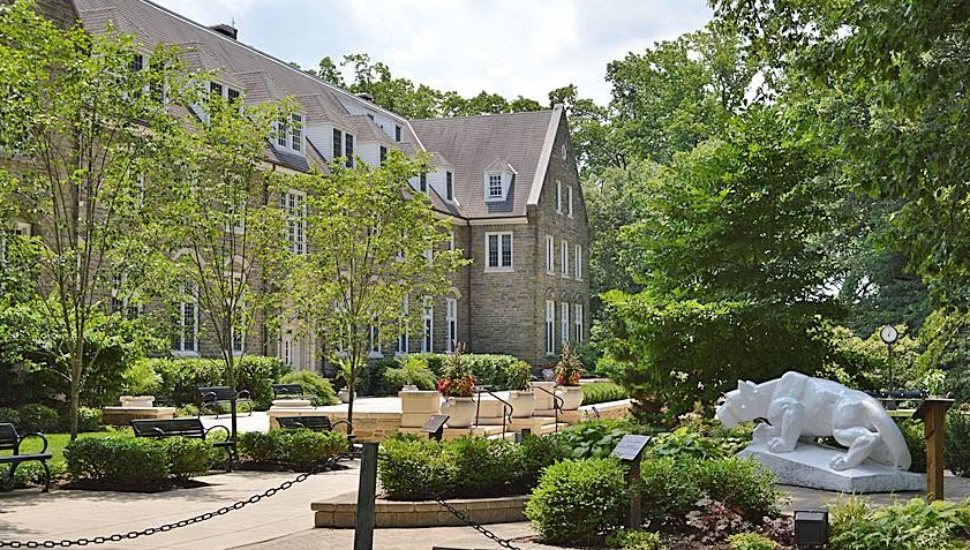
Penn State Abington is entering one of the most significant construction periods in its 76-year history, writes Ryan Mulligan for The Philadelphia Business Journal.
Nearly $100 million in capital projects are either underway or recently completed on the Montgomery County campus.
A New Academic Building, Five Decades in the Making
The centerpiece is a $68 million, 85,554-square-foot academic building that reached substantial completion this spring and is preparing to open for the fall 2026 semester.
It will be the first new academic building on campus since 1973. Chancellor Gary Liguori calls the milestone long overdue.
The three-story structure will house 17 classrooms, four laboratories, collaborative spaces, faculty offices, and student support areas.
The admissions center will also relocate to the front of the building. This will give prospective students and visitors a more prominent entry point to the campus.
Athletics Facility Gets Long-Awaited Upgrade
Penn State trustees recently approved a $25 million renovation of the campus’s primary indoor athletics facility, which was built in 1973 and has never had air conditioning.
Construction will begin this month and finish in September 2027.
The project will modernize the 53-year-old building and bring it up to current standards.
Biology Labs Already Refreshed
An already complete third project added to the campus’s momentum. A $5 million renovation of biology labs in the Woodland Building finished in 2025. It included new layouts, updated finishes, and upgraded equipment to support modern laboratory instruction.
Together, the three projects represent a comprehensive reinvestment in a campus that went more than half a century without a new academic building.
Abington Spared as Penn State Closes Seven Campuses
The timing is significant. Penn State trustees voted in May 2025 to close seven branch campuses, DuBois, Fayette, Mont Alto, New Kensington, Shenango, Wilkes-Barre, and York, after the 2026-27 academic year, citing declining enrollments and unsustainable operating costs.
Penn State Abington was never in that conversation. As one of the university’s seven largest Commonwealth Campuses, it was explicitly designated for continued investment.
That investment is happening even as Abington’s own enrollment has declined, falling from 3,728 students in 2019 to 2,715. The drop largely comes from the same post-pandemic demographic pressures affecting higher education nationally.
Campus leaders say the new facilities will reverse that trend by giving prospective students a compelling reason to choose Abington over competing options in a crowded Philadelphia-area market.
Diversity, Four-Year Degrees, and Transit
The campus has other advantages to build on. It remains one of Penn State’s most diverse, with 56% of students identifying as non-white and roughly 30% commuting from Philadelphia.
Abington offers four-year degree programs, not just the two-year associate degrees that characterize many branch campuses. This gives students access to a full Penn State bachelor’s degree without leaving the region.
Transit access rounds out a pitch that campus leaders believe can land with a new generation of students.
Liguori said that the decades-long gap without a new academic building had created an opportunity to fundamentally rethink what Penn State Abington could become.
The construction now underway is his answer.
Learn more about the projects reshaping Penn State’s Abington campus in The Philadelphia Business Journal.