
As the YMCA celebrates its 175th anniversary nationally, the YMCA of Greater Brandywine (YGBW) is focused on what comes next here, in Chester County.
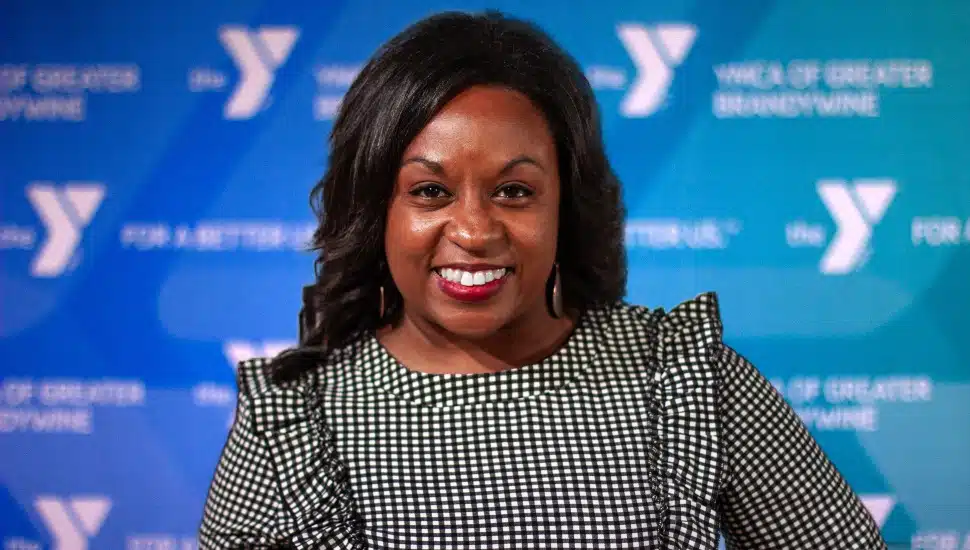
That work is being driven in part by Heather Worthy Wilson, Chief Growth and Strategy Officer at YGBW, who has spent the last year helping to shape the organization’s three-year strategic plan, a plan with a vision to create a stronger, heathier, and more connected Chester County. You can read the full plan on the YGBW website.
We sat down with Heather to learn about how her formative experiences in her hometown of Pittsburgh, a city that continues to experience vibrant transformation, helped to shape her leadership style and influence YGBW’s vision.
Where were you born, and where did you grow up?
I was born an only child in Pittsburgh. Steeler Nation.
What did your parents do?
My mom worked for the Federal Reserve Bank for 41 years. She started in check processing and worked her way up to community affairs. I loved going to visit her at work. She had this big office. I didn’t know anyone with an office like that.
After she retired, she volunteered for 20 years at North Hills Community Outreach, and now she works part-time at the member services desk for a YMCA in Maryland. She just turned 83.
My dad was in the military and then worked for Xerox, and then he started his own marketing and promotional gift business in Pittsburgh called Oscar’s Ltd. He ran that until his 70s. He’ll be 83 this year, too.
What do you remember about growing up in Pittsburgh?
We lived in a townhouse in West View, and I remember being one of the only families of color in the area, but it wasn’t a thing for me back then. I didn’t know any different.
Then we moved to where my mother grew up, in McCandless, which is also north of Pittsburgh. It was this nice big house on a corner lot, and all my friends wanted to come over for sleepovers and stuff. But again, we were the only family of color.
I used to ride my bike to the park at age eight or nine, and when I think about it now, I would never let my daughter ride by herself to a random playground that’s out of my sight. But you did stuff like that back then.
I loved going to Kennywood Park.
My dad had season tickets to the Steelers games. I was a big Franco Harris fan.
Is there a Steelers game you went to that stands out?
I remember one, when it was very cold, and our feet were freezing from being on the concrete. My dad brought newspaper to put under our feet, and it helped our feet stay warm.
And I remember a time when I was three or four, and Franco Harris got hit, and I was screaming at the top of my lungs, “They’re hurting my Franco!”
My mom and I remember that like it was yesterday.
Did you have a part-time job and what kind of lessons did you learn at those jobs that still influence you today?
I worked in the bakery department at the grocery store, and I liked having my own money so much that I started working an additional job at Lerner New York at Ross Park Mall.
I learned that people are counting on you to be on time. Sometimes there would already be lines at the store when I got there to open. If you’re late, you could ruin someone’s day.
Another is being a team player and developing a respect for operations. Seeing how everything in this massive grocery store worked together and how each person contributed to it all.
Did you play sports in high school?
I ran track. I was a sprinter. I did the 100, the 4×100, and the 200. Running track, and later straining my hamstring, is what propelled me into the sports medicine field.
I went to school, both undergrad and graduate, for athletic training.
What kind of music floated your boat in high school and college?
I like all music, but I would say hip-hop and R&B. The ’90s and early 2000s are my thing, but I love old-school soul, blues, and jazz, too.
Did you have a favorite musical artist growing up?
Let me tell you how deep my Michael Jackson love goes. When I was almost four, I was at a Pirates game with my dad, and there was a Michael Jackson impersonator. I was going nuts.
My dad had some connections as a businessman in Pittsburgh, and he went up to the guy’s publicist and got him to come to my fourth birthday party. All the kids had aviator glasses on. The cake had Michael Jackson’s glove on it. I know all his moves to this day, but I could not even move. I was so stunned.
In ’88, my dad took me and my mother and cousin to see Michael Jackson on the Bad World Tour at the Civic Arena. It was phenomenal.
I’m going to assume you were a pretty good student. You could have gone anywhere to college. Why Pitt?
Pitt had a great sports medicine and athletic training program. And I wasn’t ready to leave Pittsburgh. Looking back, what I love about Pitt is that Pittsburgh has deep roots as an industrial town and has really re-imagined itself, whether it’s through the university, or sports, or technology, or healthcare.
Some other cities that were more blue-collar have not developed as much. I loved that about staying in Pittsburgh, and I got to spend more time with my friends and family, too.
And, of course, I got to work as a student athletic trainer with many different sports, which was great.
Looking back over your career, who were the people who saw promise in you and opened up doors for you?
I’ll start with Rob Blanc. He was my athletic training professor and the head athletic trainer at Pitt when I was there. He let me do all kinds of athletic training stuff over the summer with the football team. He took me under his wing and helped me a lot in the athletic training space.
Then I got to grad school. I didn’t have a mentor that really stood out there, but after my first full-time job at Hampton University right out of grad school, that’s when I interviewed to be the head athletic trainer for the Seton Hall University men’s basketball team. I didn’t expect to get the job, because you didn’t see women, let alone women of color, in that space.
The person who opened the door for me there was Louis Orr. He played for Syracuse and then for the Knicks in the NBA. He was the coach at Seton Hall at the time, and we just hit it off. Before I was even out the door, he told Sheila Echeverry, the Director of Sports Medicine, “We’re hiring her!” She was also instrumental in my career.
Tell me how you ended up at the YMCA of Greater Brandywine.
I was at Seton Hall University from 2005 to 2011 and went through three coaches. By the end, the hours were intense, and I was ready to stop living out of a suitcase.
I started working part-time at a YMCA in Summit, N.J., first as a fitness floor coach and then teaching group exercise classes. Eventually, they asked if I wanted to become a full-time wellness director.
That opportunity launched my career in the YMCA movement. I worked my way through YMCAs in Summit and Metro Washington before meeting Bertram L. Lawson II, our President and CEO, at a conference in Minnesota. We shared a similar vision on the role the YMCA could play within the health innovation and wellness space, a role much larger than a traditional YMCA. We connected professionally, stayed in touch, and he later recruited me to serve in YMCA leadership roles in Baltimore, Syracuse, and eventually to the YMCA of Greater Brandywine.
There are still relatively few women of color serving in number two leadership roles within the Y movement, and I’m grateful for the leadership development and opportunities Bertram provided along the way. Those experiences helped position me for where I am today; not because I am a woman of color, but because of the merit, value, and leadership I bring to the work.
Being the only Black woman in a space wasn’t new for you. How do you deal with the reality of that situation?
The reality is the reality. It shaped me from a very young age, when I didn’t even recognize it.
Everybody needs to deliver results, but in my mind, the expectation for me is so much higher. That’s built a different work ethic in me that will never leave. The reality isn’t going to change.
I’m a Black woman. Acknowledging it, embracing it, being proud of it, but not making it a limiting factor, helps me navigate it.
I can dance on the same dance floor with different shoes. I understand that different situations may require a different approach; but at my core, I remain authentic to who I am, my values, and where I come from. I don’t change who I am to fit the room. I simply know how to navigate the room while still standing firmly in my identity because I love who I am.
Here we are, a third of the way through 2026. What are your challenges? What are your opportunities? What are you focused on?
My role is broad. It’s not just about managing initiatives; it’s about helping shape where the YMCA of Greater Brandywine is going over the next three to five years and beyond.
I focus on three core questions: Where should YGBW play to win in the future? How do we align the organization around that direction? And what capabilities do we need to build to execute that strategy effectively? That’s where the opportunity exists to unlock both growth and mission impact.
One of the biggest challenges is balancing growth with mission. There’s pressure to grow revenue, but you never want to drift from the core purpose of the Y or over-commercialize the experience.
Another major opportunity is changing the external perception of the Y, especially in health and community outcomes. We’re doing incredible health strategies work, but many still see the Y as a program vendor instead of an integrated partner in the healthcare continuum that can help bridge the gap between wellness and clinical care.
We’re also focused on strengthening our technology and data infrastructure, so we can truly operate as a data-driven organization.
And a key part of our strategic plan is expanding access and expanding our footprint. That requires the right capital, talent, brand positioning, and delivery models. While brick-and-mortar branches remain important, we’re also focused on alternative, community-based models that allow us to meet people where they are.
We always talk about the Y doing 10,000 different things, but really, we do one thing, serve communities, 10,000 different ways.
What do you do with all that free time that you have?
I work out a lot, cook, and spend time with my family. Mainly, my daughter, Alana, takes up a lot of my time. She’ll be seven.
I like traveling when I can. Seven of us do an annual girls’ trip. It’s somewhere different every year, and I always look forward to that escape. We went to Scottsdale, Arizona last year.
I love to read. I’m addicted to Audible.
What was the last book you read?
There There by Tommy Orange. It’s a fascinating book about the Native American Indigenous experience in Oakland, California. And I read a lot of self-motivation and self-help books too.
Three last questions for you, Heather. What’s something big that you’ve changed your mind about over the last 20 years?
I’ve come to understand, if there’s consistently the same problem, sometimes you’re the common denominator. Sometimes I need to step back and see how I’m contributing to the problem, and often times, the root is this idea of perfectionism.
That was really hard for me, because when you go through life as a perfectionist, it’s both a gift and a curse, because no matter how successful I am, I’m never going to be perfect.
I just went to see the Michael Jackson movie, and there’s a piece in it about perfectionism. It was when he performed at the 25th anniversary of Motown and showed the world the moonwalk for the first time.
I remember watching that on the TV in 1983. My family, the whole world, was going crazy over this. He spun around, went up on his toes, and then came back down. To a normal person, it was like, “Oh my God, what did we just witness?”
But in the movie, at the end of this performance, what Michael Jackson said was, “I didn’t stay on my toes long enough.”
That hit me like a ton of bricks. I wrote it on a sticky note and put it on my bathroom mirror. It’s a reminder that you could be giving it your all, and you still will find a way to be your own worst critic. Now, I remind myself that I stayed on my toes long enough, and I am enough.
It’s a crazy world out there. What keeps you hopeful and optimistic, Heather?
That’s easy, my daughter! I look at her every day, and I know I need to make sure she sees a healthy balance between work and play.
What keeps me going is that she is looking up to me. I don’t have to be perfect. I don’t have to be on all the time.
I just have to be real and show that there are a lot of different emotions you can have and need to have. You just have to keep them under control.
She can do anything. The only person who can beat her is her. Being that role model for her is what keeps me hopeful and optimistic every day.
Finally, Heather, what’s the best advice you’ve ever received?
Around the time I started working, my dad told me, “It’s not about who you know. It’s about who knows you.” That stuck with me.
Success isn’t defined by the size of your network, but by the strength of your reputation within that network. I have access to people who can open doors for me, but do they trust me enough to do it? Do they stand behind my leadership?
It’s my integrity and credibility that have propelled my career. The most powerful form of leadership is leading through influence and knowing people will advocate for you when you’re not in the room.