
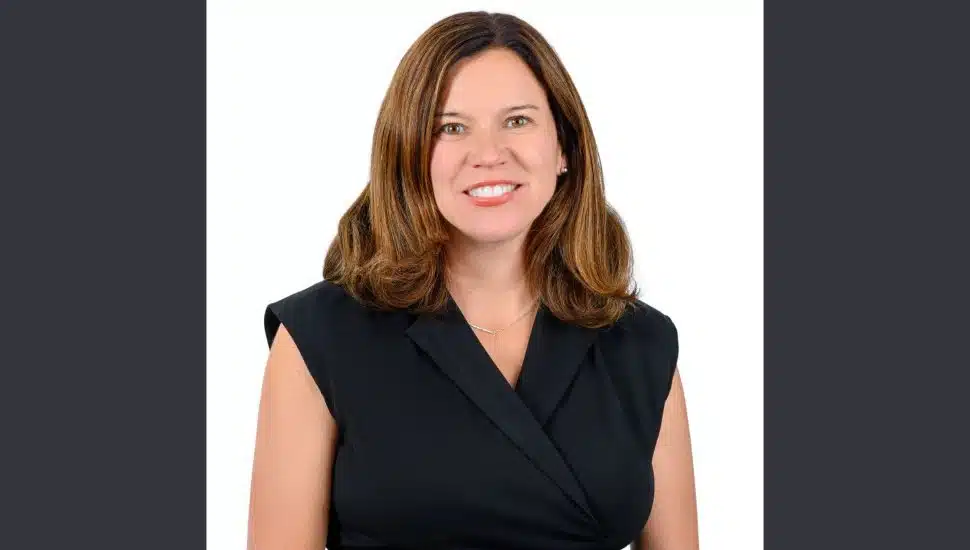
Colleen Arnold, President of Aqua, spoke with VISTA Today about growing up as one of six children on Staten Island and discovering a passion for serving others in high school. She was fascinated by New York City’s water system from an early age and studied engineering in college to cultivate her interests.
A Civil Engineering graduate from the University of Massachusetts Amherst, Arnold discussed her dynamic technical and corporate career in water treatment, serving New York City, Philadelphia, and Wilmington, and now overseeing operations across Aqua’s eight-state footprint. She shared the story of her career path, her meditation practices, and the books she’s reading now.
Where were you born, and where did you grow up?
I was born the fifth of six children in Brooklyn, N.Y., and I grew up in Staten Island.
What did your parents do?
My mother was a homemaker. My father worked in sales for General Electric, but he spent the majority of his career at an international shipping company called Maersk Moller. He got promoted to the regional sales and territory manager for New England.
What do you remember about growing up on Staten Island?
I have good memories of Staten Island. We had a big family, and I had a lot of free time. I remember going out to play in the neighborhood with friends and my mom wouldn’t know where we were, but we knew we had to be home at a certain time. It’s very different from the way my daughters were brought up.
Did you have any jobs while you were growing up?
My first job was at a video store. I think I started my sophomore year of high school. I loved it. I made $3 an hour off the books, and I thought it was a lot of money. I had to buy all my clothes, so it came in handy. I wore a uniform for a Catholic school, but anything I wanted beyond basics or hand-me-downs from my sisters I had to buy for myself.
I kept that job for a couple of years. One of the customers needed a babysitter, so then I started babysitting after school and on weekends.
What do you think you learned from those jobs that still influence your life?
I learned from my job at the video store that I enjoy helping people. And no matter how angry or rushed people are, you’ve got to meet them where they are when you’re in customer service. You can’t get upset that they’re upset. Even today at work, I believe in meeting people where they are and understanding where they’re coming from.
And then babysitting; there’s a lot of responsibility there. And, like I was saying with customers, I learned that I’m good with children.
Where did you get that ability to understand people?
I think it comes from growing up in a big family and watching my four older brothers and sisters. They were always jockeying for position since they were so close in age. I was much younger and always observing their dynamic. I was always trying to understand, “Why is this one fighting with this one?”
What about sports? Did you play any sports in high school or when you were a kid?
I did. I went to a Catholic school and we were all encouraged to do Catholic Youth Organization sports. I played softball, basketball, and soccer and ran track, but I wasn’t particularly athletic.
Did you do anything in high school to distinguish yourself?
I was definitely a good student. I went to St. Joseph Hill Academy, a competitive all-girls Catholic high school on Staten Island. I was involved in the yearbook, and I wrote for the school newspaper. I also volunteered for a Christian organization.
I’ve always been really involved. Something I’m trying to learn to do — still, to this day — is when to say no.
What kind of music floated your boat while you were growing up?
I shared a room with two sisters, and I was the youngest, so I didn’t get a choice with music. One of my sisters, Anne, was all about Madonna and Blondie and girl bands, and some disco and Michael Jackson. My other sister, Cathleen, was into Bruce Springsteen and rock.
When they left for college, I gravitated toward alternative rock — anything they didn’t like.
You were going through your rebel stage, right?
Yes. I had an asymmetrical haircut. It was as red as a Catholic school would allow.
Where did you end up going to college, and why there?
My dad put all six of us through college. I thought I wanted to be a teacher. A lot of my family was in teaching. But my dad told me that since he was paying, I would need to go to a state university, and I’d have to become an engineer.
I went to SUNY Buffalo for a year. My dad got a big promotion at his job and was transferred up to Boston. So, I transferred from SUNY Buffalo to UMass Amherst, where I got a degree in civil engineering. My first year at SUNY Buffalo had a big impact on me, though.
Why did your experience at SUNY Buffalo have such a big impression on you in just that year?
Freshman year of college is such a pivotal time. I see this with my daughters and nieces as they’ve experienced this first year on their own. I went to a small Catholic high school, so that was my first year of independence, when I was meeting so many different people. It’s such a transformative time. I had one of my first serious boyfriends, and made different friends.
Was UMass Amherst a good choice?
It was. Since my father encouraged engineering and I had been fascinated by New York City’s water system since I was young, I wanted to become an Environmental Engineer and focus on water work. UMass had a strong drinking water-specific program. And I met some of my best friends at UMass.
After graduating with a Civil Engineering degree, I wanted to go back to New York City, so I got my master’s at Manhattan College in Environmental Engineering.
Looking back over your career, who saw promise in you?
Manhattan College has a strong environmental engineering program focused on water quality monitoring and bringing the Hudson River back to life. I was on fellowship, and there were a couple of professors there who saw something in me. Professor Jeris and Professor Thomann helped reinforce the interest I had in water.
There was also a professor at UMass who encouraged me while I was working in the environmental engineering laboratory. The support and encouragement of those professors early on reinforced that I was on the right path.
What do you think those professors saw in you?
I think they saw that I’m smart and passionate. I throw my all into everything I do.
How did you end up at Aqua?
One of my first projects after earning my master’s degree was piloting drinking water treatment for New York City at different locations in the watershed. It was a dream assignment for me. It gave me the bug for Operational Engineering.
The professor I told you about from UMass always stayed in touch with me. He convinced me to go back to school and get my Ph.D. so I could become a Professor. He also gave me the opportunity to pilot this advanced technology. I was writing up the papers and presenting on it, and he said that it was too applied. I would need to spend another couple of years doing research. At that point, I decided that academic research wasn’t for me. I was too applied, and I didn’t want to relocate anywhere in the country. But it was a great experience.
I took a year off and taught high school math at a private school in Maryland. I had always wanted to teach. Teaching — doing it well and communicating and understanding your students — was one of the hardest things I’ve ever done.
Then, I went back to engineering and worked as a consultant to highlight water treatment for the City of Philadelphia Water Department. Next, I worked on the utility operations side for Wilmington, Del., as their water quality manager. By this time, I had started a family. I’ve made decisions that have been the best for me, not just career-wise, but balancing life with my family.
After that, I never left utility operations. I spent eight years working for Wilmington in different roles, starting in water quality and moving up to a director role, where I got more into utility management. Then I moved over to Aqua. In 2015, I became deputy chief operating officer. Five years later, I was promoted to president.
As you’re looking into this new year, what’s your focus? What are your priorities? What are your challenges?
Our theme for this year is back to basics. We’re focusing on training, maintaining solid operations, and doing what we do well. We’re always looking to innovate and do things better while staying focused on safe, reliable water and wastewater.
How are you attracting new people?
That’s a great question, and something that keeps me up at night. We want to be the employer of choice. During COVID, we had to focus on recruiting when McDonalds could be paying more for entry-level positions. That forced us to up our recruiting game. But recruiting hasn’t been as tough lately.
Retention has been a focus. We’ve been transparent on different growth paths within the company. We’ll have a career ladder portfolio that will show all of the positions across Aqua, so that people can see different career paths within the company. We want to be completely transparent about the different opportunities and skill sets needed for different roles. And we believe a diverse culture makes for a better environment for our employees.
We’re doing a good job attracting employees; it’s the retention part that’s in training. We are focusing on setting them up for success and giving them the right training tools. In the old days, new employees were just set up with the most senior operator and that was it. There’s still a lot of wisdom to get from that senior person, but we need to do better than that. We’re working a lot on SOPs, more formal training and more reinforcement. And we always work on paying competitively.
Aqua operates in 8 states. Every state does things a little differently, so one of my challenges is to let the states run with things locally while also recognizing when to standardize. We can look at how to implement successes from Ohio or Pennsylvania in other states. For example, Ohio did their own training videos and they were fantastic. We’re taking some creative approaches, and one of the key parts of retention is getting the right training.
So, Colleen, what do you do with all that free time that you have?
I like to golf when it’s warmer out. I like to walk and hike, stay physically active, and spend time with my family and friends. I’m an avid reader. I read two or three books at a time.
What’s on your nightstand right now?
We were just in London, so I bought this History of the World book from the British Museum. I’m also rereading One Hundred Years of Solitude by Gabriel Garcia Marquez, which I first read in my 20s and loved. There’s a show coming out on Netflix about it. It’s interesting when you read a book 30 years later.
What keeps you hopeful and optimistic? It’s a crazy world out there.
I am deeply spiritual. I believe in goodness and love and beauty and truth. I find hope every day in people and I try to put my energy into that.
Do you meditate?
I do. I try to find time during the day. I follow a spiritual guide named Richard Rohr. He sends out daily meditations, and I’ll try to carve out at least 10 minutes a day to read and think.
Finally, Colleen, what’s the best advice you’ve ever received?
I have different mantras. One of them is from a Sister at high school who would quote Sir Francis Bacon: “Be so true to thyself as thou not be false to others.”
You can’t be true to others, and you can’t lead others unless you think about, “Well, who am I?” This trueness to myself is tied to my spirituality, and it has always been my guiding star. … Something greater than ego.