
While most American cities have a history, Philadelphia has a blueprint.
Much of the concepts that are common in American society — from public libraries to emergency rooms and labor rights — were drafted here first.
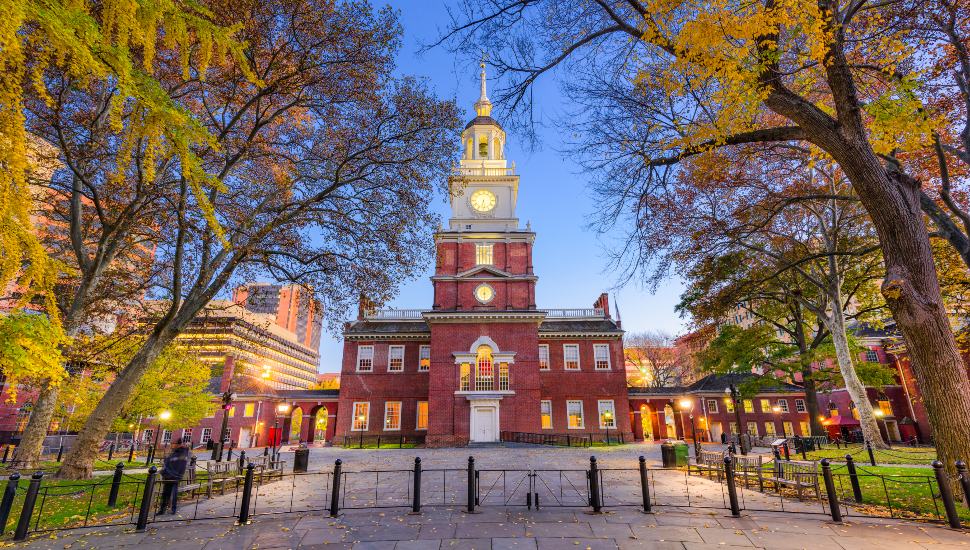
Independence Hall gave the world the Declaration of Independence and the U.S. Constitution.
But the more remarkable story is what happened after the ink dried.
Philadelphia became the place where revolutionary ideals got stress-tested against reality, where abstract principles about democracy, public health, free speech, and civic life were turned into functioning systems.
Many of those systems are still running today.
The Hospital That Started It All
In 1751, Benjamin Franklin and physician Thomas Bond petitioned the Pennsylvania colonial assembly for something that didn’t exist anywhere in America: a public hospital.
Their argument was straightforward — the sick poor were dying in the streets because no institution existed to treat them.
Pennsylvania Hospital opened that year and hasn’t closed since.
It established the model for organized medical care in the United States and eventually helped make Philadelphia one of the country’s leading centers for physician training.
The infrastructure Americans rely on when they walk into an emergency room has roots in that 1751 petition.
Libraries, Fire Companies, and the Logic of Civic Life
Franklin’s fingerprints are elsewhere, too.
In 1731, he helped found the Library Company of Philadelphia — not a private collection for the wealthy, but a membership library where ordinary citizens could pool resources and share access to books.
It was a radical idea: that knowledge should be accessible to people who couldn’t afford to own it.
Public libraries, taken for granted today, trace their democratic logic directly to that experiment.
Franklin also organized the Union Fire Company in 1736, introducing the concept of coordinated volunteer firefighting at a time when a burning building mostly just burned.
Both institutions reflected something Philadelphia kept returning to, which is the idea that civic problems required civic solutions.
The Free Press Was Practiced Here First
Philadelphia’s print shops were the internet of the Revolutionary era — chaotic, opinionated, and impossible for authorities to fully control.
Newspapers and pamphlets published there fueled debates about independence, taxation, and the limits of government power.
The culture of public argument Americans associate with a free press didn’t emerge fully formed from the First Amendment.
It was practiced and refined in Philadelphia’s coffeehouses and printing offices for decades before the Constitution was written.
Finance, Industry, and the Machinery of a Nation
Philadelphia served as America’s financial capital during the nation’s formative years.
The First Bank of the United States, chartered in 1791 and headquartered on Third Street, established foundational precedents for a national banking system.
It generated fierce political battles about federal power that echo in economic debates to this day.
Later, Baldwin Locomotive Works, founded in 1825 in the heart of the city, became one of the largest locomotive manufacturers in the world, helping bind the country together with rail infrastructure at a moment when that literally meant national survival.
The Budd Company pioneered stainless steel railcar manufacturing in the 20th century.
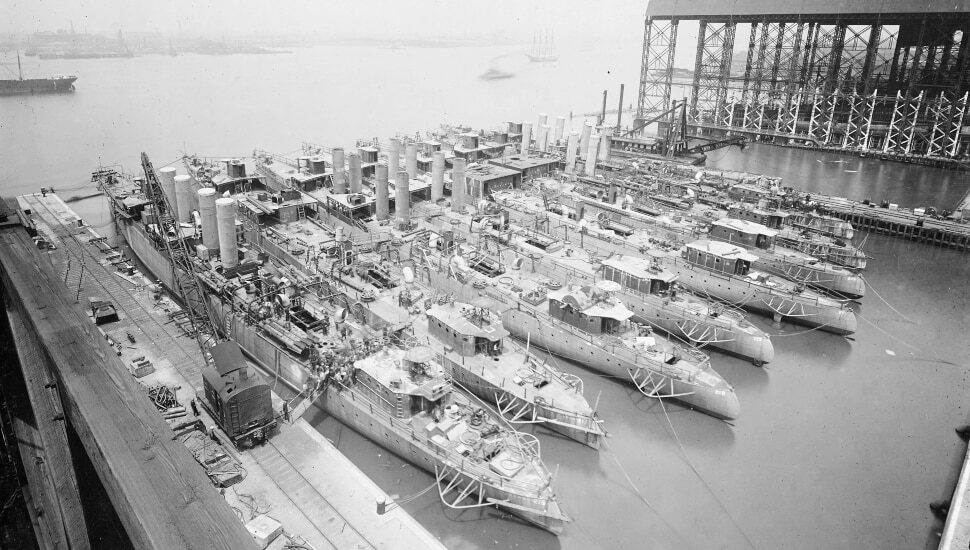
The Philadelphia Navy Yard built warships that shaped the outcome of two world wars.
Black Philadelphia Also Built the Country
In 1787, the same year the Constitutional Convention met in Philadelphia, the Free African Society was founded here by Richard Allen and Absalom Jones.
It was one of the first Black mutual aid organizations in the United States, providing financial assistance, community support, and a model for collective self-reliance at a moment when the new nation’s founding documents still permitted slavery.
Allen then went on to establish Mother Bethel African Methodist Episcopal Church in 1794.
In doing so, he created an institution that became a station on the Underground Railroad, a hub for abolitionist organizing, and a template for Black civic and religious life that spread across the country.
The A.M.E. Church today has over 2.5 million members.
The Immigrant City
Philadelphia’s immigrant communities rewrote the place just as thoroughly.
Irish workers who came to dig the Schuylkill Canal in the 1820s stayed and built neighborhoods in Kensington and Fishtown.
Italian families created South Philadelphia’s commercial and cultural fabric over generations.
Jewish immigrants from Eastern Europe concentrated in neighborhoods around South Street, establishing institutions, businesses, and civic organizations that shaped Philadelphia’s political character for a century.
Puerto Rican communities built Fairhill and Hunting Park.
Southeast Asian refugees, many arriving after the Vietnam War, settled in South Philadelphia and established communities that transformed whole neighborhoods.
Each wave arrived, preserved something, adapted, and left a mark the city still carries.
Labor’s Long Fight
Labor organizing ran through all of it.
Philadelphia’s dockworkers, factory hands, and transit workers built some of the country’s earliest and most combative unions, fighting battles over wages, safety, and dignity that helped establish the legal and cultural foundations of American labor rights.
The city’s working-class neighborhoods were not just places people lived; they were political organisms, producing the kind of sustained, organized resistance to industrial power that eventually produced the eight-hour workday and workplace safety laws.
Sound, Art, and the Shape of the City
Philadelphia’s cultural exports, which less systemic are no less real.
The Philadelphia sound — developed at Sigma Sound Studios in the 1970s by producers Kenny Gamble and Leon Huff — helped define soul music for a generation and shaped the global pop landscape in ways that still show up in contemporary production.
The city’s mural arts program, launched in 1984, became a national model for using public art as community intervention.
Its dense rowhome neighborhoods and walkable grid, laid out by William Penn in 1682, influenced how American cities were designed and how urban planners still think about livable density.
The Throughline
The throughline is real, and it runs straight to the present.
From the hospital on Eighth Street to the church on Sixth, from the print shops of the colonial era to the recording studios of the 1970s, Philadelphia kept generating the institutions, arguments, and communities that made America worth believing in.
What happened in Philadelphia wasn’t a moment.
It was a method — and America has been running on it ever since.