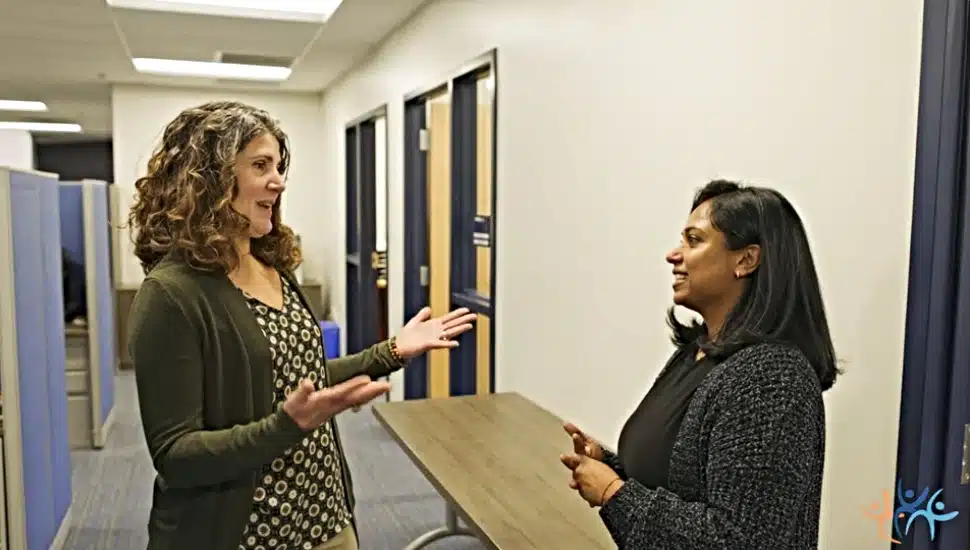

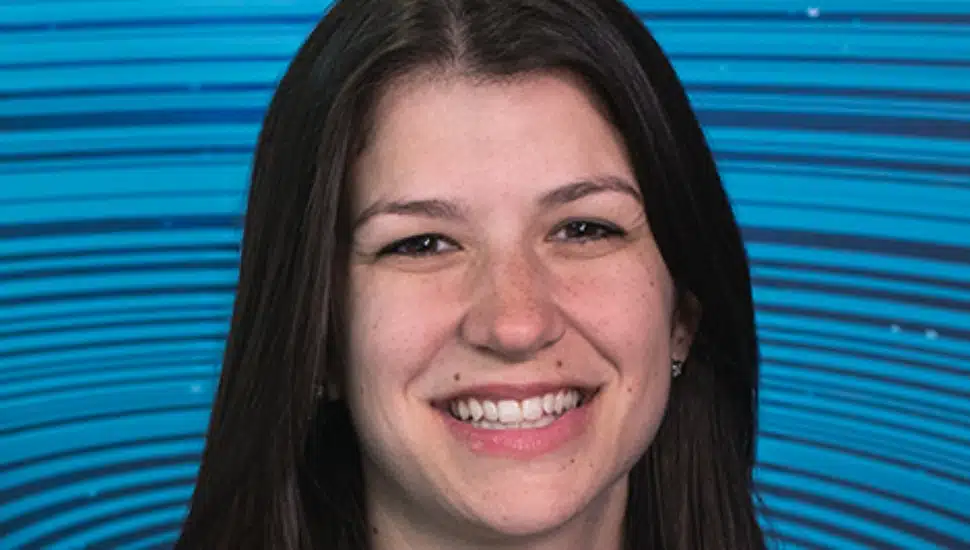

Emily Gatto, Director of TLC Wellness at The Lincoln Center, grew up in Wyndmoor. As a kid, she loved a wide range of music and worked hard at part-time jobs as a teenager, but she struggled with school due to an undiagnosed learning disability.
With the support of her parents and a few other key adults, including one who inspired her to study social work, Gatto graduated from Millersville University. Last year, she joined The Lincoln Center and launched TLC Wellness, their outpatient therapy practice. Gatto discussed what’s next for TLC Wellness and the life lessons she’s learned from CrossFit.
Where were you born, and where did you grow up?
I was born the youngest of three kids and the only daughter, in Philadelphia, and grew up outside of Chestnut Hill in Wyndmoor.
What did your mother and father do?
My mom’s a career ER nurse. She worked at Chestnut Hill Hospital and a few different hospitals around the country. My dad was a medic.
What do you remember about growing up in Wyndmoor?
I was fortunate to grow up in Springfield Township — a safe, suburban neighborhood where we played in the street without worry. I had supportive parents and access to a strong education.
Did you play any sports while you were growing up?
No, I had trouble finding that thing. Sports are tough if you don’t start at a certain age, and my parents didn’t know how to do that. In middle school, I tried to start playing field hockey and — forget it.
How did you distinguish yourself in high school?
I was pretty directionless. I struggled academically. Girls, statistically, fall through the cracks when it comes to diagnosing if there’s a learning disability or ADHD. Because I was anxious, I internalized it. I wasn’t causing a behavioral issue in the classroom.
I was certainly not someone that the school’s like, “Oh, this kid needs help.” But I failed every test I ever took. I couldn’t even name the capitals in fourth grade. But for some reason, even failing every single test, no one said, “Hey, something could be wrong here.”
So, school was hard, and then finding my place with people and peers was hard. I tried to find where I could get some positive reinforcement. When you’re not doing great at school, when you don’t feel super confident, when you don’t have direction with athletics, you usually fall into the wrong crowds because they give you positive reinforcement.
I probably wouldn’t look like the face of that, especially now as a perfectionist who won’t break the rules in my adult life, but it was very different in my teenage life, mostly because I was just trying to find a place to fit in.
What was it that gave you grounding? How and where did you find yourself?
Having a few key people, primarily adults, in my life through my teenage years, where I knew I was safe, was so important. They helped give me some direction. Also, I was raised by extremely hardworking parents, where rolling over and doing nothing was not an option.
When they were growing up, my parents had the space to make mistakes, so they were very intentional. They were like, “We’re not going to let you go full throttle, but we recognize you need to figure some things out.”
I also had this inner drive of, “I know I have to do something.” Not going to college or doing nothing just didn’t feel like an option for me, though, sadly, some of my friends at the time struggled with addiction, and a few even lost their lives.
I was fortunate to have support and a sense of direction that kept me focused on moving forward.
Did you work when you were a teenager?
Yeah. I babysat and then got started with jobs at 14. My parents expected us to earn our own money. The longest one — I was in and out of a few — and the best was an after-school program at a local daycare.
What kind of music floated your boat in high school and college?
I loved anything and everything. I was a big records person. I love Janis Joplin and The Beatles. I also grew up with Metallica. There was not much censorship in our house. I remember running around at six, headbanging to Metallica. So, it’s very diverse.
Now I love Taylor Swift and pop. But in high school, it was a lot of Bob Marley, the Beatles, the Doors, and Led Zeppelin. If I could be in any generation, I would be the seventies.
When you got done with high school, you were still wandering. How did you get to Millersville, and why Millersville?
I went to community college in my first year at Montgomery County Community College. Again, I was pretty directionless. Thank goodness, at that time, Facebook was getting popular. My friends who went away to college were posting all these pictures. I was like, “This looks so fun. I’m sitting here in my hometown. I need to get out.”
I had a friend going to Millersville at the time. He needed a ride home for one of the breaks, so I offered to drive him if he gave me a tour. I did apply to a few similar in-state schools. But I loved Millersville. The campus is beautiful. It’s this perfect mix of getting out but also having some kind of bubble, which was comforting.
Looking back, was Millersville a good choice for you?
A hundred percent. I was the kid who didn’t even like to do sleepovers. My dad brought me, and when we got there, I was like, “I can’t go in.” He was like, “You’re getting out of this truck and going in. Or we’ll take you out of school, but you’re not coming home.” Thank goodness for that.
So, I went in, and it took me a day until I was like, “This is my place.”
What did your father see in you in that moment that told him that you needed that push?
I don’t know. Again, this is the privilege of having parents who were always supportive of me. I don’t know specifically, but he probably saw this from a young age. I see it in my oldest. It’s this drive. You have so many talents, and we’re not going to let that go to waste.
Looking back over your career, Emily, who were the people who saw promise in you?
I’ve mentioned a few key adults who helped guide me during times when I wasn’t always making the best decisions. One of them was Beth Ann Bunting, my childhood neighbor and a social worker. When you’re not excelling academically, people don’t often talk to you about your potential or future possibilities. But seeing the work Beth Ann was doing really inspired me — it gave me a sense of direction. That inspiration ultimately led me to pursue social work at Millersville.
Who else saw promise in you?
Larry George, who worked at the County in Lancaster, was my supervisor during grad school. Again, he provided this safe space as I was navigating things and also gave that positive reinforcement of, “Hey, when you speak, people listen.” He told me that I was excelling in my first job.
The next one that comes to mind was when I was interviewing at the Children’s Hospital of Philadelphia. The woman who became one of my clinical directors, Dr. Jen Mautone, noticed that I mentioned billing and other business aspects on my resume, which people don’t usually think about. She recognized that, and I ended up getting the job.
How did you end up at the Lincoln Center?
I was looking at what would work best for my family, and I saw a job for the Lincoln Center for Family and Youth, overseeing their school-based counselors. It was a school-year job. Summers were either very light or off, and the hours were school hours. I thought that would be good from a family perspective. I applied for it, and I got a call the next day. They said, “We just offered that position to someone, but we have this other idea in mind. It’s this wellness thing.”
I met with Rob D’Alonzo, who oversees all of our school-based stuff, and then Dr. GT Freeman, our CEO. They wanted to open an outpatient therapy practice. I’ve never started a business. I’m a clinician. It was hard for them to find someone who does the clinical work but can also be business-minded. And I love the business side, although I didn’t know that yet.
Give me a quick overview of what the Lincoln Center does.
We are a nonprofit. Through education, counseling, coaching, and consulting, we empower people to make positive choices, meaningful connections, and transformational change.
The Lincoln Center in Audubon is a comprehensive hub offering:
- Therapeutic support via TLC Wellness.
- Alternative educational environments through its Leadership Academy.
- School-based mental health services in partner districts.
- Community outreach and capacity building through counseling, consulting, coaching, and educational initiatives.
So, what are you focused on personally within the Lincoln Center this year? What are your priorities?
Last year was year one of TLC Wellness, our outpatient therapy group that I was brought on to build. I had to hit the ground running — bring clients in to serve, build a website, network, tell people who we are, even design the logo — everything.
So, last year was all about building and bringing awareness. This year, I’m focused on process. I’m trying to nail down the processes for both my staff, so that they have good leadership and direction, so that they can serve best, and also for people from the community. We’re getting credentialed with commercial insurance to be accessible, having a good intake process, and having good client experiences from the front to the back.
Right now, I’m developing the TLC Wellness Diagnostic and Evaluation Center. We have psychologists on staff who evaluate children and adults for learning disabilities, autism, ADHD, IQ, and more. Our goal is to help people understand themselves better—whether it’s a six-year-old or a forty-year-old finally recognizing, “This is why things have been hard for me. And here’s what I can do about it.”
Personally, I have dyscalculia, which is like a math-based learning disability. I understand how it feels to struggle quietly. Often, the “squeaky wheel gets the grease,” but many kids — and adults — who aren’t making noise still need support. We’re here to help both.
So, what do you do in all that free time that you have?
I love being with my family. I have three little kids, a six-year-old, and three-year-old twins, and we just got a puppy. Our goal is to make her a therapy dog for TLC Wellness.
In that hour after they go to bed, I love to listen to a podcast or audiobook or watch mindless TV. I just got done with Temptation Island and I watch Traitors.
Do you have a favorite podcast?
It’s pretty diverse, but I like to listen to things that fall into that pop culture, like Juicy Scoop or The Viall Files. I listen to New Heights, because who doesn’t love the Kelce brothers?
Three last questions for you, Emily. What’s something big you’ve changed your mind about over the last 10 years?
I was not athletic growing up. I did ride horses and always found joy in animals. But in the past 10 years, I started doing CrossFit. As someone who never saw themselves as athletic or strong physically, I’ve morphed in my outlook on what athleticism means and physical capabilities, and pushing yourself. It’s never too late to find those passions.
How has recognizing that athletic side adjusted your perspective?
It’s all about tolerance. My sister-in-law is a Pilates teacher, and she says, “Your mind gives up before your body does.” When you push yourself physically — I’m not talking overexertion — but when you do things you never thought you could do, there are huge lessons in that. The more you expand that, the more you can do.
What keeps you hopeful and optimistic, Emily? It’s a crazy world out there.
Patterns of history keep me hopeful. When we look at history, a lot of things repeat. I’m not saying there aren’t new things, but we persevere. Humans are strong. There are many generations that thought, “This is it.” I mean, how did parents of the ‘50s feel when their kids were going out and girls were going from wearing skirts to pants and dancing topless at festivals? We’ve been through world wars and Vietnam and drafts.
There have been so many times in history when we were like, “This is it.” But we didn’t survive it by going, “Well, this is it. We’ve got to roll over.” My dad said once, “You can roll over, but you’ve got to get back up.”
Even in our path of trying to get credentialed with insurance at TLC Wellness, we’ve had quite a time. We’ve been trying since October, and we keep hitting roadblocks. Someone said, “You’re always so hopeful.” And I said, “Well, people don’t fight cancer by saying, ‘I’m going to die.’”
It’s mentality first. I don’t believe in toxic positivity. There’s reality as well. But what’s the solution? And if that doesn’t work, what’s a new one?
Finally, Emily, what’s the best advice you’ve ever received?
When I was attending Montgomery County Community College and preparing to transfer to Millersville, a woman I worked with at the daycare, Susan Palya, gave me advice that’s stuck with me ever since. She said, “Just remember, when you go there — wherever you go — there you are.” It was her way of reminding me that simply changing your environment doesn’t mean your problems won’t come with you.
That phrase, “Wherever you go, there you are,” has helped me set realistic expectations and offer myself grace. You can’t expect everything to change instantly just because you’ve made a big decision. Change takes time. Eventually, it all starts to make sense — but getting there can definitely be a frustrating process.
Editor’s note: Gatto has a children’s book series debuting Jul. 18 with FlutterBy Press. The June Series follows a big-hearted elementary-aged child as she navigates everyday challenges — from anxiety and nightmares to sibling squabbles and trying new things. These emotionally intelligent stories help children name their feelings, face their fears, and build confidence. Told in a playful, first-person voice, the series offers young readers empathy and insight, while giving caregivers gentle tools to support them. More information will be available soon on the publisher’s website. In the meantime, follow along on Instagram: @juneseries.books.