
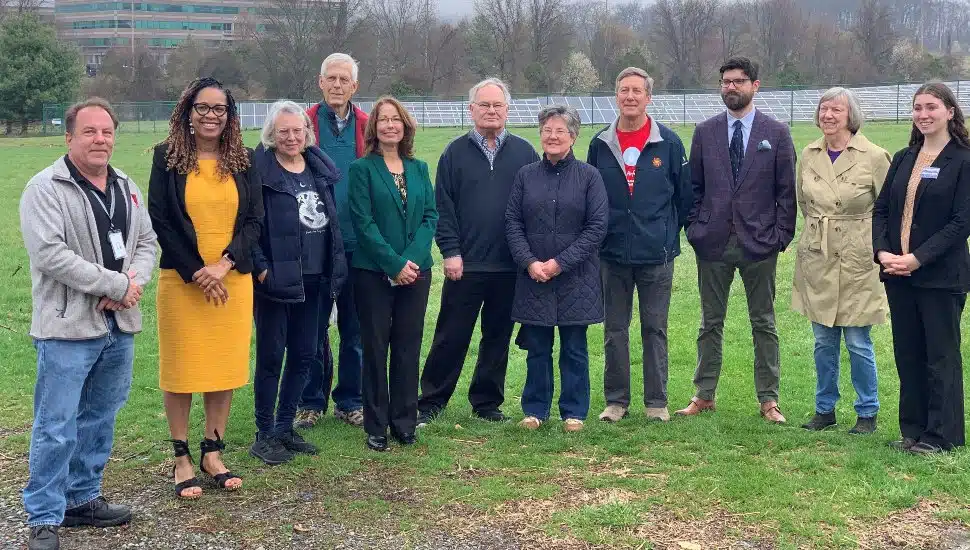
Local officials and residents joined leaders from Church Farm School, West Chester University, and the nonprofit environmental group PennEnvironment for an informative tour of the schools’ innovative clean energy projects.
The tours were held to educate Chester County residents about the benefits of solar and geothermal energy, and how they can make the switch if interested.
“There’s never been a better time for schools to use the power from both the Sun and the Earth,” said Hanna Felber, organizer for PennEnvironment. “Plentiful sunshine, constant temperatures from the Earth, and generous clean energy incentives are here. Now, more schools in Pennsylvania just need to take advantage of them.”
In 2013, Church Farm School worked with Luminace to install a ground-mounted solar array large enough to offset 75 percent percent of its annual electricity usage. The array’s 3,500 solar panels are saving the all-boys boarding and day high school on its utility bills but also eliminating tons of carbon emissions annually.
“Church Farm School has a long heritage of farming in Chester County,” said Tiffany Scott, Interim Head of Church Farm School. “Although we have transitioned from a working farm school into a college preparatory, all-boys high school, we are proud to be doing our part to reduce our carbon footprint, particularly as the cost savings helps us divert more funding to our mission. A recent $1 million investment into replacing our solar panels by our partner, Luminace, will extend the life of our system through 2050, generate 1.3 million kilowatts of green energy in the first year of production, and save us almost 34 percent compared to current local average utility rates. Our solar farm is also a wonderful tool to teach our students about sustainability in an ever-expanding world.”
WCU has also made clean energy upgrades. In 2009, it began installation on a geoexchange system, which is responsible for heating and cooling nearly half of the buildings on campus.

“About 1.7 million square feet, over 40 percent of our campus building spaces, are heated and cooled (with the geoexchange system), which is more energy efficient with lower carbon technology,” said WCU Vice President of University Affairs Andy Lehman. “This commitment to geoexchange technology is one of the university’s efforts to become more environmentally, socially, and economically sustainable as an institution of higher education.”
For both CFS and WCU, their clean energy upgrades have delivered significant savings to the schools on their monthly electricity bills. Other schools that want to follow suit have the added benefit of tax credits that can dramatically lower the price tag for going solar or switching to geothermal.
Solar energy is abundant, efficient, and increasingly affordable, and schools are often great candidates for both rooftop and ground-mounted solar panels. Harnessing more energy from the sun would mean cleaner air, a more stable climate, less strain on natural resources, and an energy source we can depend on to be virtually pollution-free for as long as we can imagine. Plus, going solar increases energy independence and reliability and allows schools to save money on their utility bills.
Similarly, geothermal is a great alternative to traditional fossil fuels. Systems such as heat pumps take advantage of the stable temperature of the Earth just a few feet below the Earth’s surface. Geothermal heating and cooling lowers energy use, lowers climate emissions, lowers air pollution, and saves consumers money on their utility bill, all while producing zero direct emissions.
“Unfortunately, here in Pennsylvania, despite the fact that we are a big energy producer, we do not have a lot of renewable energy sources,” said State Rep. Chris Pielli. “We’re still relying on carbon-based energy; too much of it is shale gas, which of course has an impact on our environment. Fifty-nine percent of Pennsylvania’s instate generation comes from natural gas, with renewable energy sources accounting for only four percent of our whole grid. And that’s bad.”
Right now, Pennsylvania is currently ranked 26th in the nation for solar power. School leaders hope that their array can inspire other schools across Pennsylvania to follow their lead, choose clean energy, and help Pennsylvania become a solar leader.
“The energy transition in progress is a one-way ticket driven by the economic advantage of clean energy,” said Shaun Walsh, West Goshen Township Chair of Supervisors. “Supporting clean energy is no longer about climate change; it is now about maintaining American economic leadership. With guidance from smart policymaking, government and institutional leadership, and our risk-taking private sector, I believe Chester County can be on the front line in Pennsylvania for the clean energy technological transition underway. The economic future is bright!”