

You can’t have driven anywhere around the Delaware Valley without passing a place where George Washington is reported to have spent the night.
From riverbank farmhouses to stone taverns and battlefield headquarters, the story of America’s first commander in chief is written across our back roads and boroughs, one restless night at a time.
Washington’s overnight stays weren’t just about finding a bed; they were about keeping a fragile revolution alive.
His lodgings doubled as command centers, field hospitals, and moments of fragile unity when defeat felt imminent.
As filmmaker Ken Burns puts it, “Without [George Washington], we don’t have a country … [He’s] a deeply flawed human being … without whom we would not have a country, period full stop.”
Here’s a county-by-county look at five local places where Washington really did, or is credibly reported to have, slept.
Philadelphia — The Germantown White House (Deshler-Morris House)
Tucked into Germantown’s leafy streets, this 18th-century stone home twice sheltered Washington during the yellow fever outbreaks of 1793 and 1794.
It’s America’s oldest surviving presidential residence and a quiet reminder that even presidents need refuge.
Today, visitors can walk the same parlor floors where the Washingtons dined while the capital city struggled to stay alive.
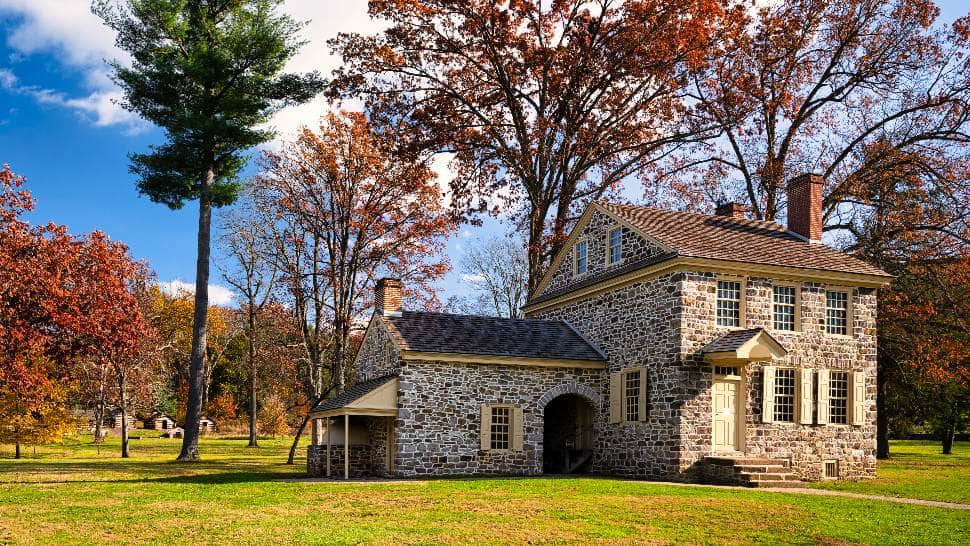
Montgomery County — Washington’s Headquarters, Valley Forge (Isaac Potts House)
At Valley Forge, Washington spent the brutal winter of 1777–78 in a modest stone home overlooking the Schuylkill River.
Inside, he wrote letters that reshaped the Continental Army, from supply chains to discipline, and rallied a demoralized force.
The house still stands as the heart of Valley Forge National Historical Park, its small rooms echoing with enormous decisions.
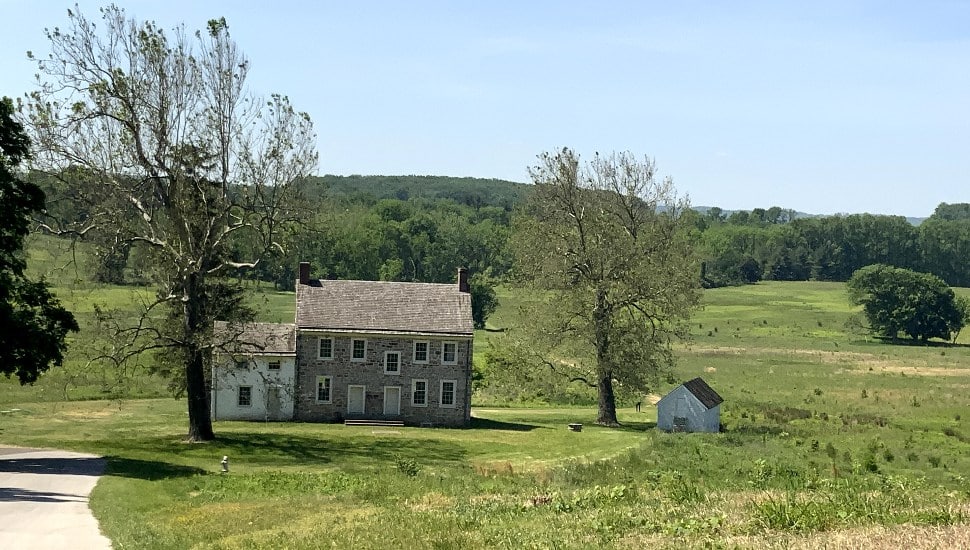
Delaware County — Benjamin Ring House, Brandywine Battlefield
On September 11, 1777, Washington used Quaker miller Benjamin Ring’s home in Chadds Ford as his headquarters during the Battle of Brandywine.
From this riverside dwelling, he strategized against the British advance on Philadelphia.
The defeat that followed was bitter, but the site marks where Washington’s resolve hardened into endurance.
Chester County — The Washington at Historic Yellow Springs
A mile or two west of Valley Forge, Washington lodged at this country inn during the 1777 Philadelphia Campaign.
Nearby, he ordered the establishment of a military hospital to tend wounded soldiers.
The inn, still operating under the same name, remains a cornerstone of Chester County’s Revolutionary landscape, where the war’s suffering and humanity converged.
Bucks County — The Moland House, Warwick Township
In August 1777, Washington made the Moland House his headquarters while 11,000 troops camped nearby along the Neshaminy Creek.
It was here that the Marquis de Lafayette first joined his staff, cementing one of the war’s most consequential alliances.
Few homes in America can claim such a turning point under their roof.
A Thread That Still Connects Us
This isn’t a comprehensive list of all the places Washington slept in and around Philadelphia; there are dozens more scattered across back roads, small towns, and forgotten crossroads.
But from Germantown’s cobblestones to the fields of Brandywine and the hills of Valley Forge, the Delaware Valley is stitched together by Washington’s footsteps.
His humanity and leadership, equal parts fallible and fearless, turned a rebellion into a nation.
______
The full biography of George Washington from Biography.com.
Editor’s Note: This post first appeared on VISTA Today in November 2025.