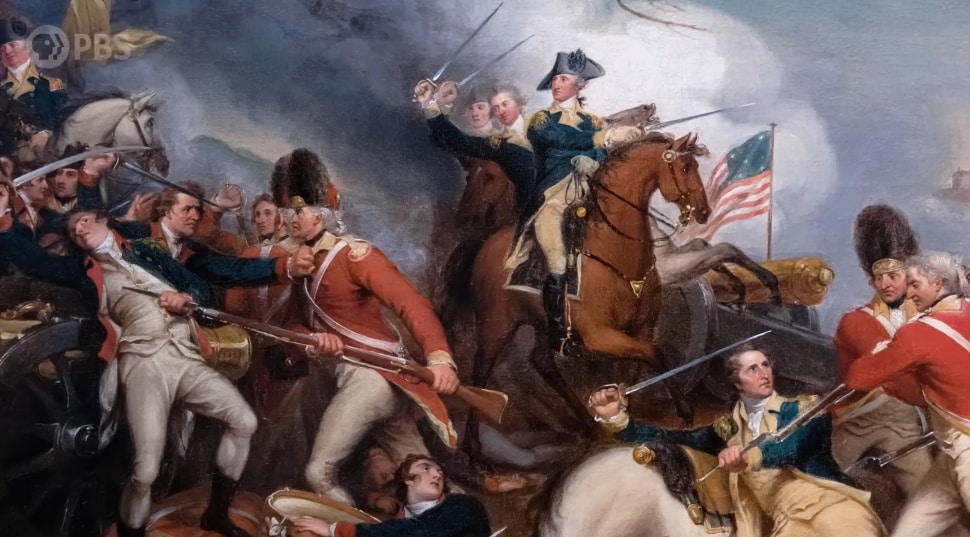

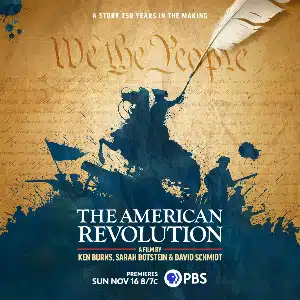
When Ken Burns sat down with Joe Rogan last month and called the American Revolution “our first civil war,” it caught a lot of people off-guard.
The phrase stopped Rogan cold, and it’s been bouncing around ever since.
Was Burns exaggerating for dramatic effect, or was he pointing out something we’ve missed all along about the war that created the United States?
You decide.
What Burns Meant
Burns wasn’t trying to shock anyone.
As he explained, he sees the Revolution not simply as a rebellion against a foreign king, but as a war fought within the American colonies themselves. “Neighbors were fighting neighbors,” he told Rogan. “Families were torn apart.”
He’s long been drawn to the human side of history, the messy, emotional part beneath the myths.
His upcoming PBS series, The American Revolution (premiering this Sunday evening at 8 PM on WHYY), promises to show that side again. It’s filled with stories of ordinary colonists forced to choose between loyalty to the Crown or loyalty to the new cause.
Burns wants us to feel the tension that existed before independence was ever declared.
The Evidence Behind the Claim
Look a little closer at the record, and you can see why he says it. Roughly one-third of colonists stayed loyal to Britain. Towns were and families were split down the middle.
In Pennsylvania, New York, and the Carolinas, neighbors burned each other’s barns, sabotaged crops, and reported family members to the local militia.
This wasn’t just a war of ideals; it was personal. Loyalists were tarred and feathered, their property seized. Some fled to Canada or the Caribbean to start over. Others stayed and suffered in silence.
When you look at that kind of violence, not between nations, but within neighborhoods, the “civil war” label starts to make more sense. After all, what do you call it when people who once shared pews and marketplaces suddenly become enemies?
The Echo in Today’s America
Here’s where Burns’ comment stings a little. He wasn’t only talking about the 1770s. He is talking about now.
In his view, the Revolution was America’s first great identity crisis: What kind of country are we going to be? Who belongs? Whose vision wins? He sees that same struggle replaying today, just without the muskets.
Back then, the founders disagreed on almost everything but managed to stay in conversation. Compromise wasn’t weakness; it was survival.
Burns worries that we’ve lost some of that patience with one another and that the distance between red and blue America feels wider than the colonists ever experienced.
Maybe his point isn’t to rewrite history but to remind us that democracy has always been messy and fragile, and always one bad argument away from breaking apart.
Or Is It a Stretch?
Of course, not everyone buys the “civil war” comparison. The Revolution was, at its core, a fight for independence from a foreign empire.
And once France entered the war, it became a global conflict, stretching from the Caribbean to the Indian Ocean.
The Civil War of the 1860s was something else entirely: two organized nations locked in industrial slaughter.
Calling the Revolution a civil war, some argue, risks confusing two very different kinds of battles.
So, What Do You Think?
Maybe Burns is guilty of a little hyperbole. Or maybe he’s reminding us that America’s story has always been more complicated than flags and fireworks.
What’s undeniable is that our Revolution wasn’t clean, unanimous, or simple, and neither is the country it created.
So here’s the question Burns leaves us with:
If our first war really was a civil war, what does that say about the one we’re fighting now — not with muskets, but with words, screens, and beliefs?
You decide.
_____________
Ken Burns recounts the tragic story of John Peters killing Jeremiah Post, his boyhood friend, on a hillside west of Bennington, Vermont, a powerful example of why he calls the Revolutionary War America’s first civil war.