
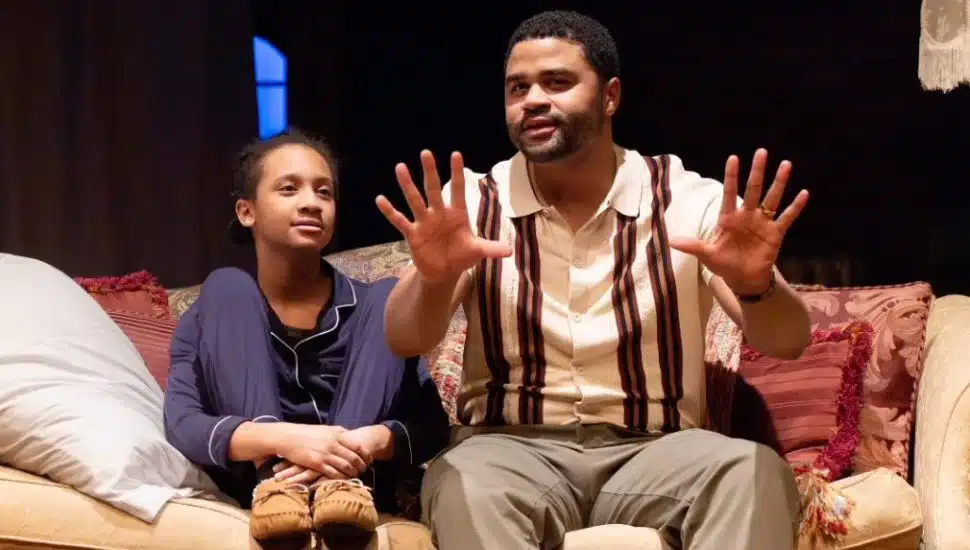
People’s Light’s production of A Raisin in the Sun was a powerful choice for the theater’s 50th anniversary season, writes Gauri Mangala for the Philadelphia Inquirer.

Even before the play begins, Lorraine Hansberry’s presence is felt as a translucent curtain bearing her portrait hangs on stage. At just 27, Hansberry captured themes of ownership, faith, and the American dream. These themes weave into the story of the Younger family’s pursuit of a better life.
Directed by Steve H. Broadnax III, the production explores the weight of multigenerational financial struggles. After Walter “Big Walter” Younger’s death, his widow, Lena “Mama” Younger (Melanye Finister), must decide how to use his $10,000 life insurance payout. She navigates the ambitions of her children—aspiring doctor Beneatha (Morgan Charéce Hall) and determined entrepreneur Walter Lee (Eric B. Robinson, Jr.)—while supporting Walter’s wife, Ruth (Candace Thomas), and their young son, Travis (Kristopher King Clark and Prince Peay).
The Youngers’ plan to move to a suburban home is met with resistance from HOA chairman Karl Linder (Todd Lawson), who attempts to buy them out rather than allow a Black family to integrate into the neighborhood. This confrontation exposes the systemic barriers that threaten their dreams.
Broadnax’s direction balances heavy themes with moments of warmth. Hall’s Beneatha is a standout, bringing modern relatability to her 1950s character. Her interactions with love interests George Murchison (Jalen Coleman) and Joseph Asagai (Nayib Felix) add dimension, with Felix portraying Asagai with authenticity and depth.
James F. Pyne Jr.’s set design conveys the Youngers’ struggle, using brick wall panels and soft-lit windows to evoke the South Side’s crowded reality. The lack of traditional walls reinforces their sense of instability.
Despite its three-hour runtime, A Raisin in the Sun captivates with gripping performances. Nearly 70 years after its debut, Hansberry’s play remains a striking reflection on racial and economic struggles. Hansberry proves that the fight for the American dream — and the question of who gets to dream it — continues.
Learn more at People’s Light.