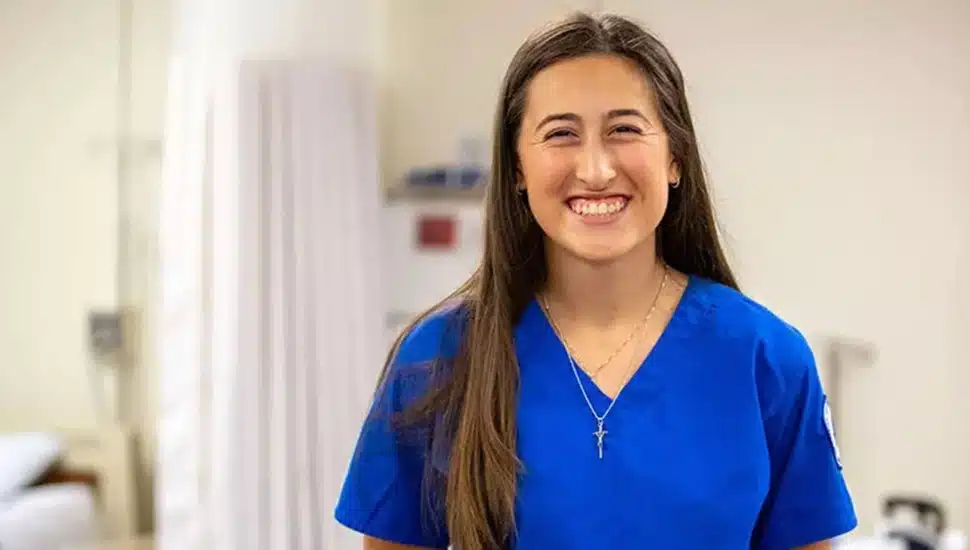

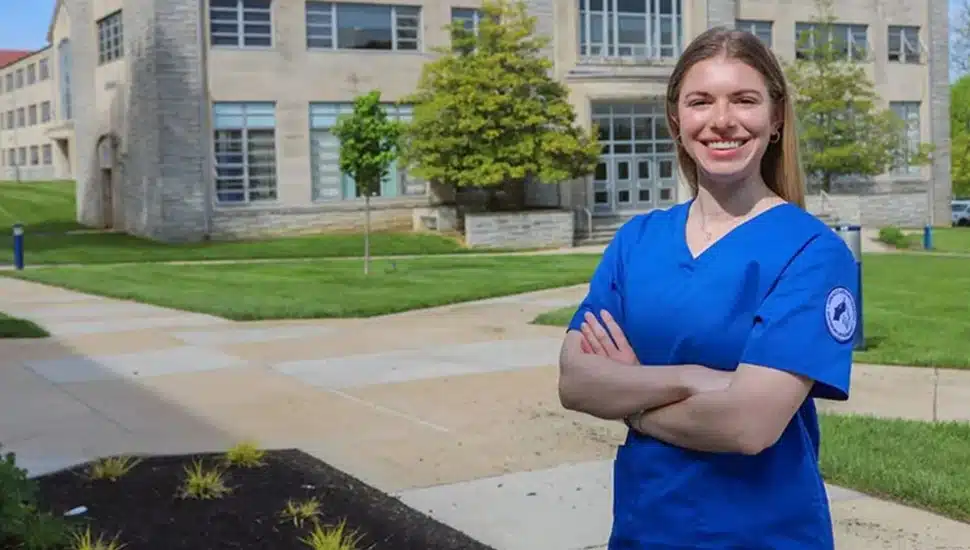

Immaculata University graduate Julia Hallman knows the value of support systems, both for herself as a student and for her patients. When she felt drawn to the field of nursing, she looked for a program that would support her as she tackled the challenge of preparing for a demanding career.
After she earned a behavioral neuroscience degree at a liberal arts college, she wanted to pursue a nursing career. She researched programs and settled on Immaculata’s second-degree Bachelor of Science in Nursing, noting its affordable tuition and the small class sizes, usually about 30 students.
“You know your professors, and they know you,” she said. “They’ll encourage you and guide you in the right direction.”
Hallman appreciated their help, along with the encouragement of her classmates, during the intense 15-month program.
“Having a support system is very important during this program,” she said.
Are you or is someone you know considering a career in nursing? The answers to these questions will help determine if nursing is a good career fit.
Immaculata University is empowering the next generation of healthcare leaders.
She spent much of her first semester figuring out a balance of studying, working part-time and managing other aspects of her life, and she gradually settled into a rhythm. As she progressed in the program, Hallman discovered how much she enjoyed helping people and making a difference in both their physical and mental health.
“You’re giving them their medications, and you’re doing assessments, and you’re making sure that their overall health is improving,” she said. “But I also think there’s a social and emotional aspect that a lot of people don’t think about.”
When Hallman completed a community clinical experience for one of her classes, she noticed that her patients didn’t have adequate support systems and often didn’t have someone to talk to. Drawing on her training in holistic nursing, she found it rewarding to connect with those patients and find things in common.
“You’re going to improve faster if you think the nurse actually cares about you and hears your concerns,” she said.
Similarly, Hallman improved as a student thanks to the caring way her instructor Venus Smith, associate nursing faculty, delivered feedback as students tried out new skills.
“Professor Smith was good at throwing us into things,” Hallman said, noting that Smith demonstrated procedures and then asked students to follow her example. On their first try, students often made mistakes, and Hallman said Smith affirmed her students while asking them to think about how they could improve the next time or sharing what she would have done differently.
Smith, a certified pediatric nurse, has encouraged and mentored Hallman, who wants to specialize in pediatrics. Hallman completed a clinical rotation in a cardiac stepdown unit at a children’s hospital and said, “You have a lot of very, very sick kids, and some don’t have a support system. I’ve learned so much, because every single nurse there is so supportive and so helpful.”
At the beginning of the clinical experience, Hallman administered medications and feedings under supervision and documented clinical information for patients. After a month at the hospital, her assigned nurse allowed her to take the lead in caring for three patients and prioritizing tasks. She analyzed electrocardiogram strips and identified premature atrial contractions in a patient. She also progressed to independently administer patients’ tube feedings and medications.
As she prepares to enter the workforce, Hallman looks forward to the support she will have through Immaculata’s network of nursing alumni.
“A lot of times, even if a nurse didn’t graduate from IU, they know someone else who did,” she said. “It’s nice that you can build connections.”
Immaculata maintains a focus on offering academic programs that meet the evolving needs of employers. Realizing that graduates do not want to be forever burdened by college debt, the university offers competitively priced and proven undergraduate and graduate degrees and certificates to traditionally aged college students, advanced degree seekers, and adult and professional learners. In fact, Immaculata’s tuition rates are among the lowest in the Delaware Valley for private institutions.
With a 10:1 student-to-faculty ratio, Immaculata enables students to receive personalized attention from caring faculty in a safe and welcoming environment. Rather than massive lecture halls and impersonal instruction, Immaculata provides right-sized learning environments that facilitate personal connections.
Additionally, with college students now having a greater demand for mental health resources, Immaculata offers counseling services and gives students access to professional help when they need it most.
Whether you’re a traditional, non-traditional, or transfer student, Immaculata offers a variety of undergraduate and graduate nursing programs that equip future nurses with the knowledge, clinical skills, and leadership skills needed to provide holistic, evidence-based patient care in a field in high demand.
The university also recently added a Family Nurse Practitioner track to its M.S.N. offerings. Immaculata’s nursing students achieved a remarkable 97.2 percent first-time pass rate on the registered nurse licensure exam, or NCLEX, in the 2022-23 academic year.