
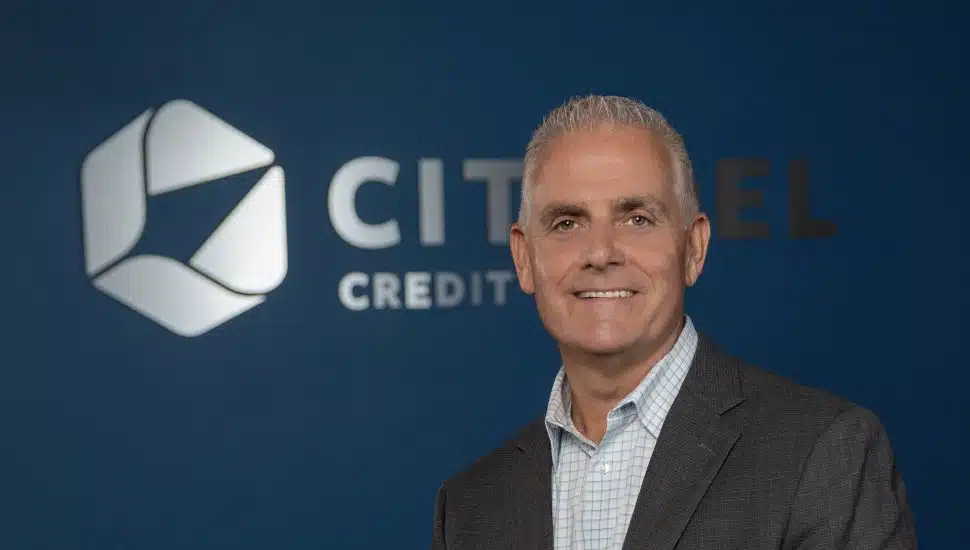
Citadel Credit Union is charting its next phase of growth and innovation, under the stewardship of new CEO, Bill Brown.
With a deep member focus and commitment to strengthening the financial well-being of individuals, families, and businesses, Brown is driving Citadel’s mission to deliver superior banking solutions with a personal touch — expanding its reach, enhancing its digital capabilities, and reinforcing its dedication to community impact through initiatives like Citadel Cares.
With decades of financial industry experience, Brown and the Citadel executive leadership team have a passion for ensuring that credit unions continue to offer a compelling alternative to traditional banking.
Brown spoke with VISTA Today about the major themes that drew him to Citadel and the advantages credit unions have over banks. He also discussed his passion for volunteering, the mentors that led to his success, and Citadel’s efforts to help small business owners.
Where were you born and where did you grow up, Bill?
I was born in New York on Long Island, in the working-class communities of Hicksville and Bethpage in Nassau County.
What did your parents do?
My father was a high school administrator, and my mother was a computer software programmer and consultant. This goes way back to keypunch cards and 10-inch round cassettes that went into a computer.
What memories stick with you from growing up in Hicksville and Bethpage?
I remember always being outside playing. From the time we got home from school until our parents made us come eat dinner or until the lights went on in the street, we were outside with kids from all around the neighborhood playing street hockey, kickball, or touch football.
Our parents didn’t hover over us. Kids from all different backgrounds, all different families around the area, were out on the street playing together. If you lost the ball, you climbed the fence into the neighbor’s yard and got it. You learned teamwork at an early age … things like how to climb on other people’s backs to get over the fence, and then how to get them to lift you back over when you got the ball (without getting caught!).
What kind of jobs did you have when you were growing up?
My brothers and I raked a lot of leaves, shoveled a lot of driveways, and cut a lot of lawns when I was young. I remember my brothers and I pulling the lawnmower and the edger behind our bicycles, going from house to house, and carrying shovels over our shoulders in the winter down snowy sidewalks looking for jobs.
My father tried to teach us about business. He provided the resources, and he expected some payback for some of those raw materials. We had to give him money for gas and to get the blades sharpened.
My first official job in which I received a paycheck was working at a grocery store in the frozen food aisle. I was stocking blocks of chopped spinach and peas, trying to keep up with whatever the sales circular was for the week that we were selling out of. It was a great experience, but it also helped influence what were some of the things I liked and didn’t like to do.
What lessons did you learn from your entrepreneurship and early jobs that still influence how you work today?
One is the idea of “just start.” Just begin something. Take a chance. The second is the value of just showing up. Even when you may not feel like you want to be there, you have a commitment, you have a responsibility.
Let me translate it into shoveling snow. You’re knocking on a lot of doors. Some people say “no” and some people say “yes,” and some people say “yes” and then they want to bargain. You’ve got to start; you’ve got to put on your hat, put on your gloves, put on your coat, walk outside in 20-degree weather, and decide, “We’re going to shovel today.”
Where did you go to college?
I went to Boston University, I chose BU because of the vibrancy of the city, the diversity, and the broad offerings of programs there.
I was an international relations major. In high school, I took a real shine to social studies, so I went to college to study international relations and political science. Boston University had a very well-known, very mature Political Science department with some great faculty.
Was Boston University a good choice for you, in hindsight?
Absolutely. I generally try not to re-trade decisions. I enjoyed it there and had a great experience. I was exposed to so much, on campus and in Boston. It was a growth spurt, if you will, for a teenager and then in my early 20s. I graduated in 1988.
Looking back over your career, including the time that you spent in the Navy, who saw promise in you, Bill, gave you opportunities that you may not have deserved at the time?
When I joined my first squadron, there was a more senior officer who took me under his wing and helped me understand how to lead people and how to navigate a squadron. His nickname was Lefty — Lefty Toscano. He was an amazing tactical expert. The man was brilliant. He inspired me to be better at my craft because he was so good at his. He brought passion to his role and empathy for other people’s circumstances. He was a great role model for what an officer could be in the Navy.
What do you think others saw in you?
Earnestness. Resolve. Grit. I think those are important character traits. As I’ve often said to individuals that we hire in our organization, we can train you to do a lot of things. What we can’t train is what’s in your heart. Technical skills are important, but I think the toolbox you come with that’s inside of you — that’s just as important.
How did you come to know about Citadel, Bill?
I’ve worked in banking since I got out of the military. I’ve worked at very large banks, global banks, as well as smaller community-based banks. I’ve had the opportunity to serve those organizations on banking committees and banking associations. So, I felt like I was very well-versed in the banking industry and the hot topics.
One of the hot topics in the banking industry is credit unions because banks view credit unions as competitors. I’ve also known about credit unions for a long time because of my service in the Navy, I was a member of a credit union.
About 18 years ago, my company transferred me to Philadelphia, and I got to know many people across the business community very well. One of the individuals I got to know was Alan Kaplan, who runs an amazing executive recruiting firm. About a year and a half ago, Alan reached out and started to talk to me about this opportunity at Citadel. Alan said to me, “You always said you want to come back to Philadelphia.” My wife and I agreed that this was our opportunity to get back to this area that we loved so much!
When his firm reached out and talked to me about this, I took them up on the offer and I raised my hand to interview and learn more about Citadel. I remember driving home from the second interview, I called my wife, and she said, “Let me guess, you want the job?” I said, “Yes! I’ll be upset if I don’t get it!”
What was it about Citadel?
There were three themes that I had to convince myself of in terms of how I thought about Citadel. One, were we operating in the right geography to offer financial services? Absolutely! There are four-and-a-half million people in our trade area, a great public transportation network, an international airport, international ports, trade, logistics, education, academic institutions, education, healthcare, biopharma, technology … you name it.
The second was, I wanted to understand the resources here at Citadel. I wanted to understand more about the board and their support for senior management and our mission, our products and services, and our technology stack.
The third was about me and our team here. Did I believe that I could come in and make a difference? I am replacing a legend. Jeff March was here for 40 years of his career, and 20 of those years were as CEO. He and the management team have built an amazing franchise. That’s where my discussions with Jeff came in. He basically said, “Look, I’ve taken us to this great place, it’s time for new leadership. And you have the background to continue us on this journey.”
So, knowing those three key themes were in place, it just felt right.
Philadelphia is often thought of as an overbanked area. You’re not a bank, but you’re a financial services firm. How do you want Citadel to be known in the marketplace?
Sometimes when people talk about being overbanked, they’re using very coarse numbers. They say, “Here’s the population. Here’s the number of banks. Here’s the number of branches. It’s got more per capita than other places.”
I absolutely believe that there is a clear lane for Citadel and for credit unions, broadly speaking, to continue to win in Philadelphia.
Our business model puts us in a different place than banks in that our members are our owners. Our financial success is our members’ financial success. Our business model allows us to offer our members higher rates on their deposit products with us. We are less reliant on fee revenue. And most importantly, when it comes to our members’ borrowing needs, it allows us to offer lower rates on the most important purchasing decisions that many people make, whether that’s an auto, business, or home loan.
I think our passion and commitment to our members and our communities still strike a chord with people throughout the region. When you understand that we are not for profit, that we don’t answer to shareholders, and that we answer to our member-owners, and understand our operating model, it positions us differently in the minds of our prospects and our communities, because we’re not in it for us. We’re in it for our members.
Here we are at the start of 2025, Bill. What are your opportunities as you look at the new year?
It’s all opportunity! A big part of that opportunity is continuing to get our message out about the great work that 580 people here at Citadel do every day. Not just here in the building or our 24 branches, but the great work they do on weekends and nights out volunteering in the community and our spirit of giving back, which we call Citadel Cares.
We’re starting to get our feet under us and build momentum in terms of the work we’re doing to support not-for-profits in our community. It’s organized around foundational principles where, when we provide funding, it’s impactful and goes towards meaningful difference-makers in our community.
Two, we also need to help people understand that in terms of our products, our services, and our digital capabilities, they are equal to — in many cases, better — to the products and services they’re getting from their traditional banking institution. Over the last decade, the technological barriers to entry have come down to the point where even the smallest financial services players across the country can present great digital solutions to their members. Our commitment is to interact with you in whatever way, whatever channel, whatever time you choose. If you still like the convenience and the friendliness of going to a physical branch location, we welcome you.
The other opportunity we have is in the small business banking space. I even hesitate to use the word “small” in front of “business,” because if you’re a business owner, you don’t think of yourself as small. Your life is invested in that business.
We want to ensure that business owners are getting value for the services that their credit union provides and that they have access to advice and good counsel when it comes to their borrowing needs. When the time comes to consider retirement plans for their employees or their future, we connect them with our most knowledgeable professionals — not for our benefit, but because we take our role as financial educators seriously.
What do you do with all that free time that you have, Bill?
My wife and I have two teenagers. My son is 16 and my daughter is 15. I am very protective of my weekends to make sure that I devote that time to them. My son is a track/cross-country runner, and my daughter has been part of a dance company for eight years. I want to do whatever I can to support them at their meets and competitions.
Does that competitive nature come from you or their mother?
Anything that’s good in my children comes from my wife. I’m very proud of their personalities and their adventurous spirit to try new and different things. I don’t know if that comes from me or it comes from my wife, or maybe they developed it.
As a parent, you need to make sure that you continue to fuel that natural energy and try not to squash that initiative or the curiosity that they display.
One of the great things about Citadel is that because we are so committed to the community, it has afforded my family and me the opportunity to volunteer together to support a number of worthy initiatives. I think that’s important — the opportunity to expose our kids to volunteerism and to show them how the little things that we do in a community support the community at large.
Finally, Bill, what’s the best advice you’ve ever received?
That best advice isn’t a quick quote but rather a role-modeled and learned behavior. … Empathy and our ability to view life through the eyes and experiences of others is such an essential part of leadership. Earlier in my career, I had the opportunity to work with two amazing leaders, Maura and John, who really lived these behaviors in the best and the toughest of circumstances, never forgetting that valuing people is a foundational building block of leadership.
Connect with people wherever they are in their lives. It’s not about changing who they are to fit the circumstance, but rather in knowing who they are and how they fit into the bigger picture.